
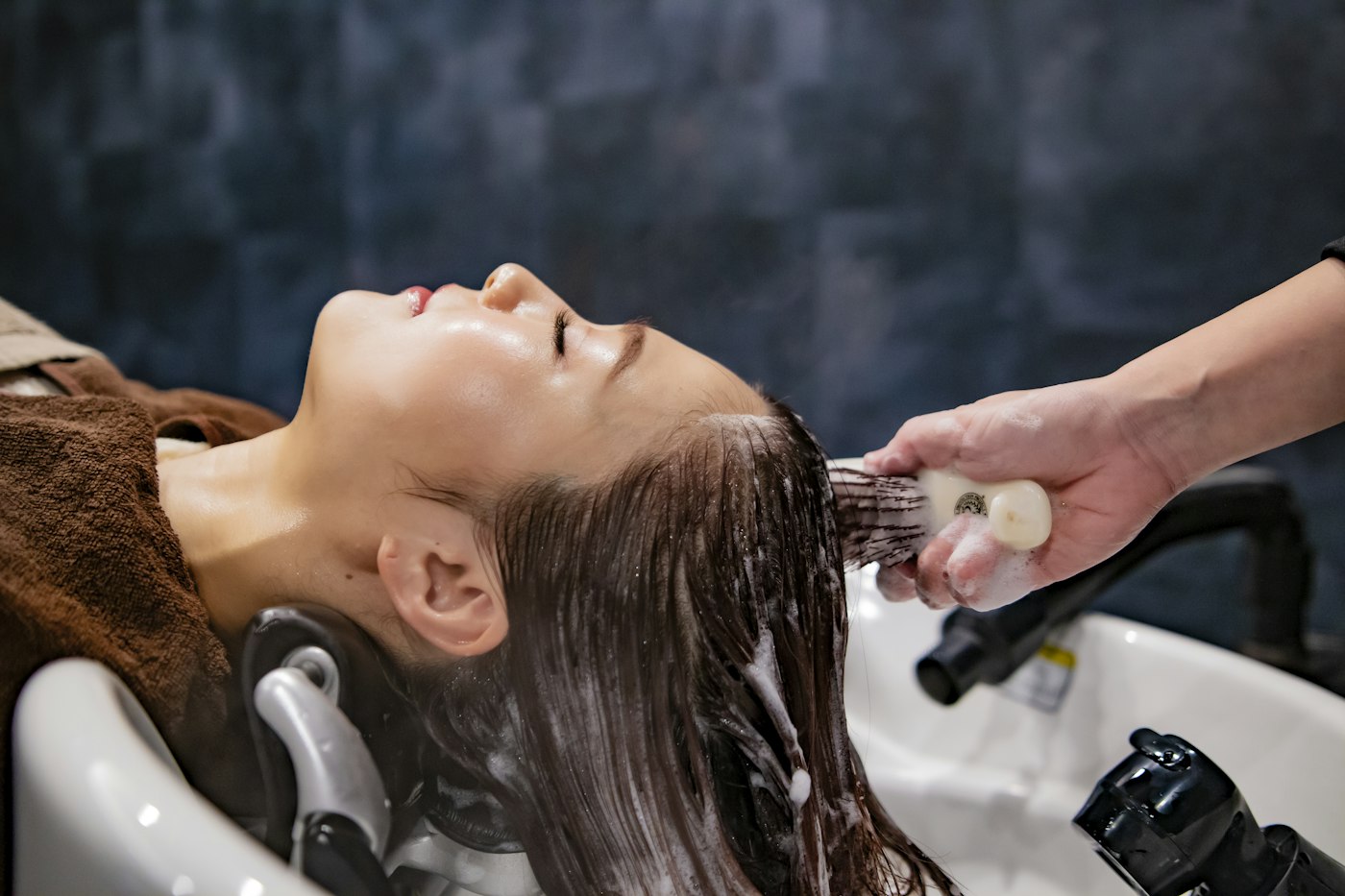
Is Your Shampoo Stripping More Than Dirt? Sulfates, Silicones, and What “Clean Haircare” Actually Means
You use it two or three times a week for your whole life, on the largest continuous patch of skin on your body. It is worth knowing what it is made of.
If your hair feels squeaky-clean in the shower and dry, flat, or frizzy an hour later — or if your scalp itches, flakes, or feels tight no matter how often you wash — it may be time to look closer at what is in the bottle you reach for every day.
Shampoo is one of the few products almost everyone uses, and one of the few almost nobody reads the label on. We buy it for the scent, the lather, and the way our hair feels the moment we rinse. Those three things are also the easiest to engineer with ingredients that are doing more than cleaning.
The short version
- Shampoo cleans with surfactants — molecules that lift oil so water can rinse it away. Some are far harsher than others, and lather is not a measure of cleaning power.
- Sulfates (SLS, SLES) are effective, inexpensive detergents. They do not cause cancer. They can strip the scalp’s natural oils, irritate sensitive skin, and fade color faster.
- Silicones give instant slip and shine, but the common non-water-soluble ones build up wash after wash — and usually need a sulfate to remove. It is a cycle.
- The single word “fragrance” on a label can stand for dozens of undisclosed ingredients.
- “Clean” and “natural” have no legal definition. A full ingredient list and a third-party certification do the work those words only claim to do.
- Switching is straightforward. Expect one to two weeks of adjustment while old buildup rinses out.
Most People Do Not Think About Shampoo Until Something Goes Wrong
A typical adult washes their hair somewhere between two and seven times a week. Over a decade, that is well over a thousand applications of the same formula to the same skin. Your scalp has more oil glands per square inch than almost anywhere else on your body, and the oil they produce — sebum — is not dirt. It is the scalp’s own conditioner, the same system we described in Your Skin Has Two Different “Plumbing Systems”.
A shampoo’s job is to remove the excess: sweat, styling product, environmental grime, and enough sebum that hair looks and feels clean. A shampoo that removes all of the sebum every time forces the scalp to respond. For some people that means an oilier scalp within a day. For others it means tightness, flaking, and a “dry scalp” that is actually an irritated one.
None of this needs to be a fear-based decision. Conventional shampoo is not going to hurt most people. But if you are already choosing carefully what goes on your face and your kitchen counters, your hair is the obvious next place to look.
What Shampoo Is Actually Doing
Every shampoo is built around a surfactant. A surfactant molecule has a water-loving head and an oil-loving tail. In the shower, the tails surround oil and dirt, the heads face outward toward the water, and the whole package rinses down the drain. Without a surfactant, water alone slides right off oily hair.
The question is never whether a shampoo contains a surfactant. It is which one, and how aggressively it works. Surfactants sit on a spectrum:
| Class | Common label names | What to know |
|---|---|---|
| Sulfates | Sodium Lauryl Sulfate, Sodium Laureth Sulfate, Ammonium Lauryl Sulfate | Strongest, cheapest, biggest lather. Efficient at removing sebum — often too efficient. |
| Sulfonates & sarcosinates | Sodium C14-16 Olefin Sulfonate, Sodium Lauroyl Sarcosinate, Sodium Cocoyl Isethionate | A different chemical family from sulfates. Milder to much milder depending on the molecule; sarcosinates are derived from an amino acid. |
| Glucosides | Decyl Glucoside, Lauryl Glucoside, Coco-Glucoside | Made from sugar and coconut or corn. Gentle, low-foaming, and the backbone of most well-formulated toxic-free shampoos. |
| Betaines | Cocamidopropyl Betaine, Cocamidopropyl Hydroxysultaine | Usually a secondary cleanser that boosts foam and softens a harsher primary surfactant. |
One thing the table makes clear: foam is a sign of a surfactant, not of cleanliness. Sulfates lather dramatically because they are designed to. Glucosides clean the same oil with a fraction of the foam. If your only measure of a shampoo is how much it bubbles, a harsher formula will always win.
The Sulfate Question
Sodium lauryl sulfate (SLS) and its gentler cousin sodium laureth sulfate (SLES) are in most drugstore shampoos, and also in toothpaste, dish soap, and industrial cleaners. That last fact gets repeated a lot online, and it is true — at concentrations that have nothing to do with a shampoo. What matters is what the ingredient does at the concentration in your bottle.
What the research says
On cancer: there is no credible evidence that SLS or SLES causes cancer. The Cosmetic Ingredient Review panel has assessed sodium lauryl sulfate more than once and concluded it is safe in rinse-off products at current levels. The “sulfates cause cancer” claim is an internet myth, and a brand that leads with it is not one to trust on the rest of its label.
On irritation: this is where the concern is real. SLS is such a reliable skin irritant that dermatologists use it as the standard positive control in patch testing — the reference other irritants are measured against. At shampoo concentrations, most people tolerate it. But for anyone with a sensitive, eczema-prone, or already-dry scalp, it is one of the most common culprits behind itching and flaking that gets misdiagnosed as dandruff.
On stripping: a strong detergent does not know the difference between styling wax and your scalp’s own oil. It removes both. Hair that has been stripped of its lipid layer is rougher at the cuticle, tangles more, and loses moisture faster — which is exactly what the silicone in the next section is there to hide.
On color: harsher surfactants speed up dye washout. This is why most colorists recommend a sulfate-free shampoo after any color or highlighting service, and why Chaé’s Tamanu Shampoo is formulated for highlighted and bleached hair specifically.
On SLES in particular: SLES is made by a process called ethoxylation, which can leave behind trace amounts of 1,4-dioxane, a contaminant the FDA monitors and describes as a potential carcinogen at higher exposures. The amounts in finished products are small, and the FDA has not banned it. It is, however, a reasonable thing to prefer avoiding when a gentler cleanser does the same job without it.
Not every “sulf” on a label is a sulfate
Label reading gets easier once you know the endings. Behentrimonium Methosulfate, which you will find in Chaé’s conditioners, is a conditioning agent derived from rapeseed oil — not a detergent, and not a sulfate in the SLS sense. Sodium C14-16 Olefin Sulfonate is a sulfonate, a separate class of cleanser that is milder than SLS. Sarcosinates, isethionates, and taurates are gentler still. Read the whole word, not the first four letters.
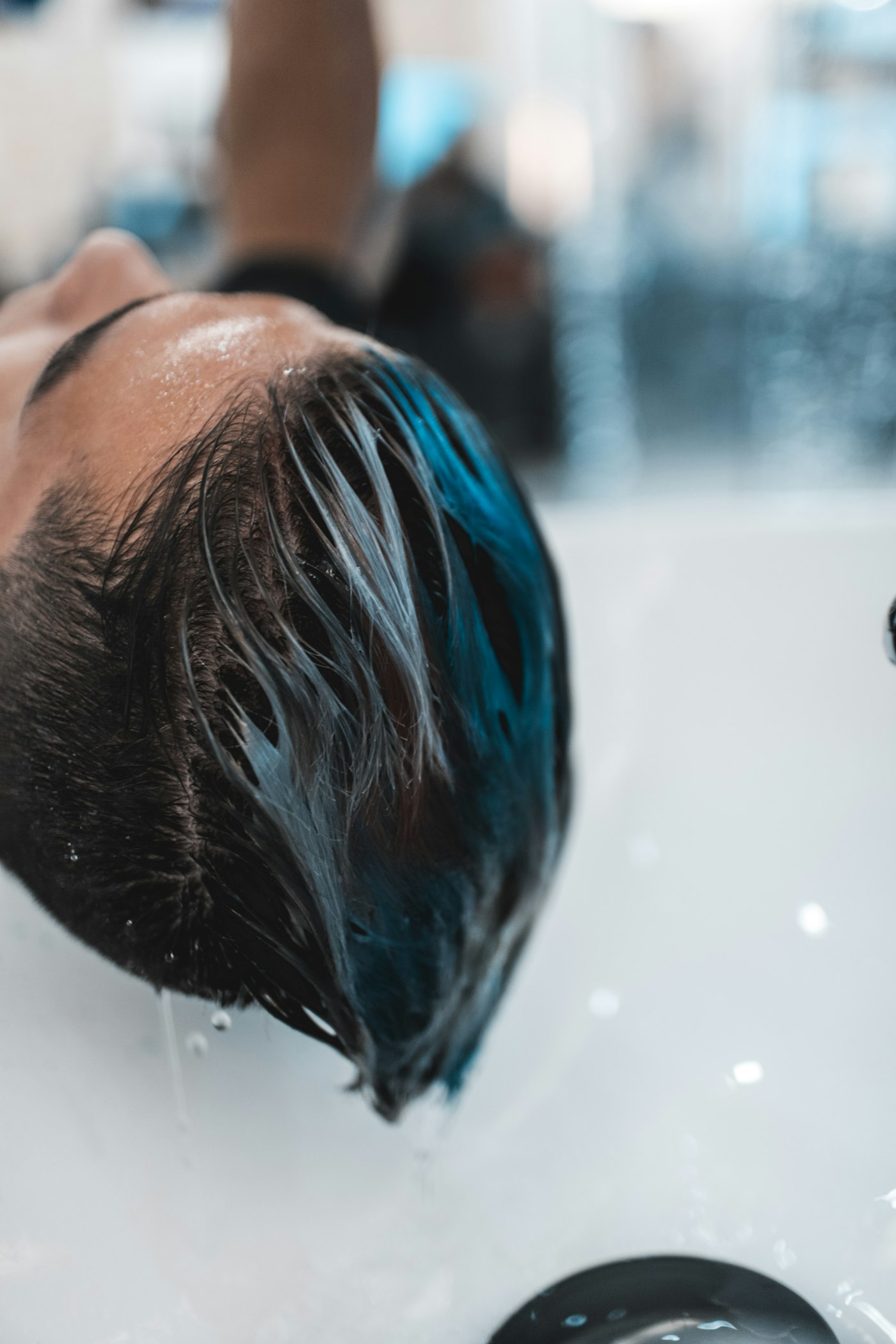
Silicones: The Shine That Builds Up
If sulfates are the reason your hair feels stripped, silicones are the reason you have not noticed. Look for anything ending in -cone, -conol, or -siloxane: Dimethicone, Amodimethicone, Cyclopentasiloxane, Cyclomethicone.
Silicones work by coating the hair shaft in a smooth, water-resistant film. The effect is immediate: slip, shine, less frizz, easier combing. It is a very convincing imitation of healthy hair, which is the problem. The film is cosmetic. Underneath it, a cuticle roughed up by a harsh cleanser is exactly as rough as it was.
The more practical issue is buildup. Many of the most common silicones are not water-soluble, so each wash leaves a little more behind. Over weeks, hair gets heavier, duller, and limp at the root, and the film blocks the water and conditioning oils that would otherwise reach the hair. Removing it takes a strong surfactant — which brings you back to sulfates.
This is why sulfate-and-silicone formulas are a matched pair. The sulfate strips, the silicone masks the stripping, and the next wash needs the sulfate to remove the silicone. It is a loop that keeps hair feeling “fine” without ever getting better.
There is an environmental note here too. Two of the most common cyclic silicones, D4 and D5, persist in waterways, and the European Union restricted both in wash-off cosmetics in 2020 for that reason. Silicones are not toxic to you. The case against them is that they coat rather than condition, and that they do not go away when you rinse.
The Word “Fragrance”
Under U.S. cosmetic labeling rules, the ingredients that make up a scent can be listed collectively as “fragrance” or “parfum,” because the formula is treated as a trade secret. A single word on the label can stand for dozens of individual compounds you have no way of seeing. Historically, that has included phthalates like diethyl phthalate, used to make scent last longer.
For the scalp specifically, this matters because fragrance is one of the most common causes of allergic contact dermatitis from cosmetics. If your scalp is itchy and you have already ruled out a harsh cleanser, an undisclosed fragrance blend is the next suspect.
The alternative is a label that names the scent. When a shampoo smells like orange because it contains Citrus Aurantium Dulcis (Wild Orange) Oil, that is the ingredient you see. You can look it up, and you can avoid it if it does not agree with you. The same goes for peppermint, tea tree, lavender, or cedarwood.
Other Ingredients Worth a Second Look
These do not all carry the same weight, and none of them is a reason to panic about the bottle already in your shower. They are simply the ingredients that a careful formulator chooses to leave out, and that you may want to recognize on a label.
- Formaldehyde-releasing preservatives — DMDM Hydantoin, Quaternium-15, Imidazolidinyl Urea, Diazolidinyl Urea. They keep a formula stable by slowly releasing small amounts of formaldehyde, which the National Toxicology Program classifies as a known human carcinogen. DMDM hydantoin in particular has been the subject of class-action suits alleging scalp irritation and hair loss.
- Cocamide DEA — a foam booster and thickener, listed under California’s Proposition 65 in 2012 based on the International Agency for Research on Cancer’s classification of it as a possible carcinogen.
- Parabens — Methylparaben, Propylparaben, Butylparaben. Long-used preservatives that can weakly mimic estrogen in laboratory studies. The evidence for harm at cosmetic concentrations is contested; the case for avoiding them is that effective alternatives exist.
- PEGs and polysorbates — PEG-40, PEG-150, Polysorbate 20. Not harmful in themselves, but made by the same ethoxylation process as SLES, with the same 1,4-dioxane question.
What “Clean Haircare” Actually Means (and What It Doesn’t)
Here is the uncomfortable part: the FDA does not define “clean,” “natural,” “green,” “non-toxic,” or “plant-based” for cosmetics. Any brand can print any of those words on a shampoo that contains every ingredient in this article. Many do.
What you can actually verify is simpler than a slogan:
- The full ingredient list is published — not just “key ingredients” or “made with.” If a brand only tells you what is in the marketing, ask what is in the bottle.
- A third party has checked it against a written standard. The ToxicFree® certification reviews every ingredient in a formula against a published list of prohibited substances. Leaping Bunny does the same for animal testing across the whole supply chain.
- The scent is named. Essential oils on the label, not “fragrance.”
- The brand tells you what it leaves out and why. Not as a scare tactic — as a formulation choice you can evaluate.
“Sulfate-free” on its own is a start, not a finish. A shampoo can be sulfate-free and still lean on silicones, undisclosed fragrance, and a formaldehyde releaser. Read past the front of the bottle.
Ingredients to Look For
A shampoo that skips the ingredients above still has to clean, condition, and smell good. This is what a well-built toxic-free formula uses instead.
Gentle plant-derived cleansers
Decyl Glucoside, Lauryl Glucoside, and Coco-Glucoside are made from sugar and coconut. They remove sebum, sweat, and product without dissolving the scalp’s lipid barrier along with it. Sodium Lauroyl Sarcosinate, derived from the amino acid sarcosine, is mild enough that it is the only cleanser in Chaé’s five-ingredient baby wash.
Tamanu seed oil
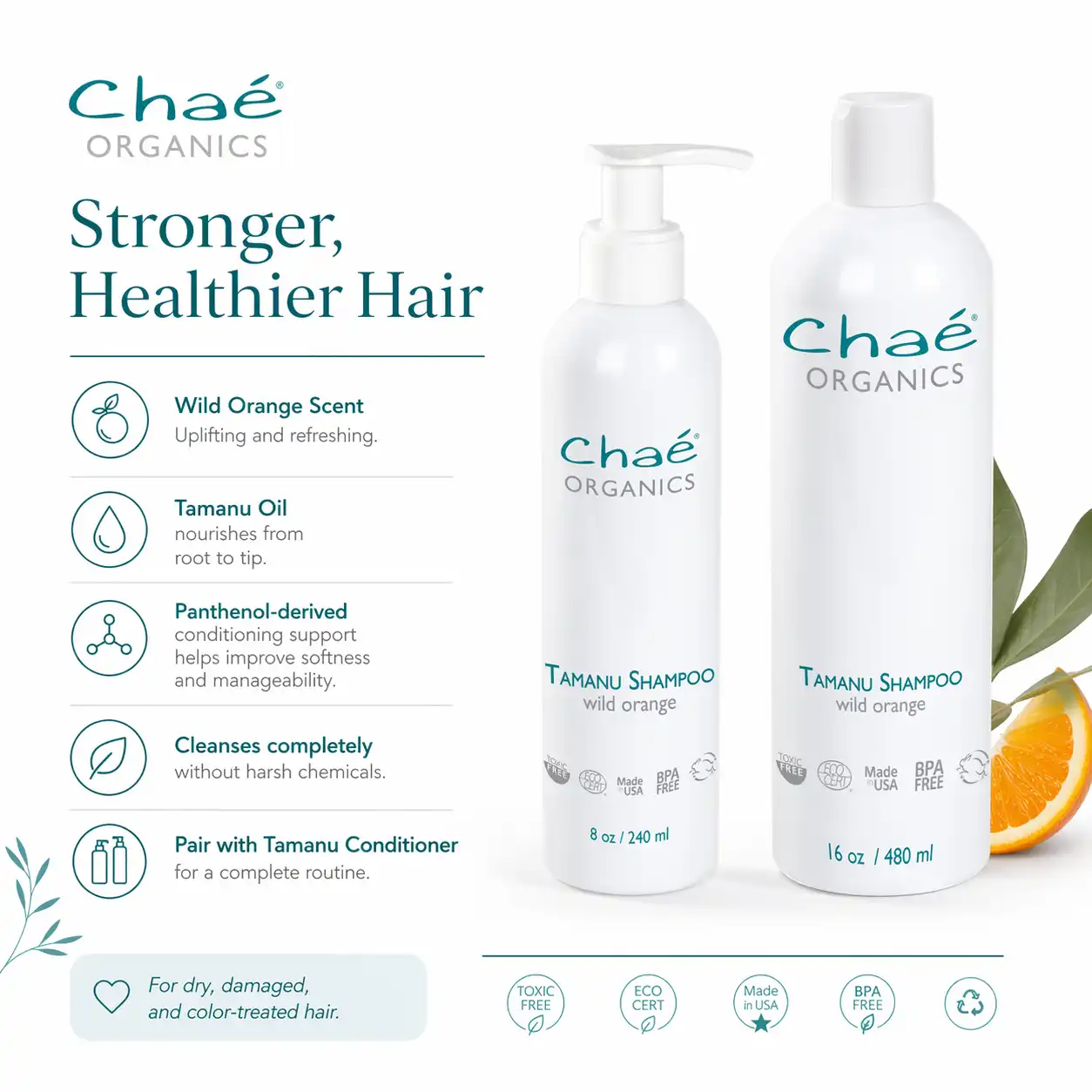
Calophyllum Inophyllum Seed Oil is pressed from the nut of a tree native to the Pacific islands and Southeast Asia, where it has been used on skin for generations. It is rich in oleic and linoleic fatty acids — the same lipids that a harsh cleanser strips away — and in hair it helps the cuticle lie flat and hold moisture. It is the headline ingredient in Chaé’s Tamanu Shampoo and Conditioner for a reason.
Hydrolyzed quinoa
Quinoa is a complete plant protein. “Hydrolyzed” means it has been broken into fragments small enough to bind to damaged areas of the hair shaft, where it acts as a temporary patch on split ends and color damage. Unlike a silicone film, it does not need a detergent to remove.
Panthenol (provitamin B5)
A humectant that draws water into the hair shaft and holds it there. It improves elasticity, which is what reduces breakage when hair is wet and at its most fragile.
Aloe leaf juice
In a thoughtful formula, Aloe Barbadensis Leaf Juice is often the second ingredient after water. It is a soothing base for the scalp and a sign that the formulator started from something calming rather than something that foams.
Real oils in the conditioner
Passion fruit, rice bran, açai, argan, and babassu oils do what silicones only imitate: they add lipids the hair can actually use. Hair conditioned with oil feels slightly different from hair coated in silicone — softer and less “slippery” — and that difference is the point.
Essential oils that do two jobs
Wild orange scents the Tamanu line. Peppermint and tea tree in the Wild Mint conditioner bring a cooling feel and a long history of use on irritated skin. Cedarwood, lemon, and lavender do the same in the men’s and baby formulas. Every one of them is on the label by name.
Your Scalp Is Skin
It is easy to think of haircare and skincare as separate aisles. Your scalp does not. It is the same skin as your forehead, with more oil glands, more hair follicles, and — because it is under hair — a warmer, damper environment where irritation can linger.
Most of the ingredients on the skincare avoid list apply here for the same reasons. If you would not put a sulfate cleanser and an undisclosed fragrance on your face twice a day, the argument for putting them on your scalp three times a week is not a strong one.
This is also the answer to a question we get about the Men’s 3-in-1. Is one product for hair, scalp, and body a good idea? It depends entirely on the cleanser. A drugstore 3-in-1 is usually a hair-strength sulfate formula used on the whole body, which is why it leaves skin tight. A glucoside-based 3-in-1 built on aloe and olive leaf is gentle enough for both, and the simplicity is a feature rather than a compromise.
How to Make the Switch
Moving from a conventional shampoo to a sulfate-free, silicone-free one is not complicated, but it goes better when you know what to expect.
- Expect an adjustment period. For one to two weeks, hair may feel less slick than you are used to. That is silicone buildup leaving, not damage arriving. Hair that has been coated for years can take a few washes to reveal what it actually feels like.
- Use less, and lather twice if you need to. Glucosides foam less, so the temptation is to pour more. Instead, work a small amount into wet hands first, apply to the scalp, and rinse. If the first pass does not feel like enough, a second small pass will — the first wash loosens, the second cleans.
- Focus shampoo on the scalp, conditioner on the ends. The lengths of your hair get clean from the rinse. Conditioner belongs from mid-length down, not on the roots.
- Rinse longer than feels necessary. Low-foam formulas can be harder to feel rinsing out. Give it an extra fifteen seconds.
- Give it three weeks before judging. The first wash tells you about the coating you had. The tenth wash tells you about the shampoo.
On frequency: the American Academy of Dermatology’s guidance is that how often to wash depends on how oily your scalp is, and there is no universal rule. What a gentler cleanser changes is the trade-off. Many people find they can wash more often without dryness, or less often without the greasy, heavy feeling that comes from buildup.
Will sulfate-free shampoo actually get my hair clean?
Yes. Glucosides remove sebum, sweat, and water-soluble styling product every bit as well as a sulfate — they just do it without the foam show. The one thing they will not remove quickly is heavy silicone buildup from a previous product. That takes a few washes, which is the adjustment period above.
The Bottom Line
Shampoo is a habit product. Whatever is in it, you are applying it to skin hundreds of times a year, and the small effects of a harsh cleanser or a film-forming coating are not small once you multiply them out.
You do not need to be afraid of your current bottle. You do need to be able to read it. Look for a cleanser that removes what you want removed and leaves the rest, a conditioner that adds something your hair can use rather than a coating that hides what it cannot, a scent you can name, and a label that has been checked by someone other than the brand printing it.
That is what “clean haircare” means when it means anything at all.
FAQ: Sulfate-Free and Toxic-Free Shampoo
Do sulfates cause cancer?
No. There is no credible evidence linking SLS or SLES to cancer, and the Cosmetic Ingredient Review panel has judged them safe in rinse-off products. The legitimate concerns with sulfates are irritation and stripping, not cancer.
Is sulfate-free shampoo better for color-treated hair?
Generally, yes. Harsher surfactants pull dye out of the hair shaft faster. If you have paid for color or highlights, a gentler cleanser is the simplest way to protect the investment.
Why does my hair feel different after switching?
Most often, because silicone buildup is rinsing out. Hair that has been coated feels slippery; hair that has not feels softer but with more texture. Give it two to three weeks before deciding.
Is “sulfate-free” the same as “clean”?
No. Sulfate-free describes one ingredient class. A shampoo can be sulfate-free and still contain silicones, undisclosed fragrance, and formaldehyde-releasing preservatives. Look at the whole list and for a third-party certification.
How often should I wash my hair?
As often as your scalp needs it — the American Academy of Dermatology does not give a single number. Oily scalps may need daily washing; dry or textured hair may do best once or twice a week. A gentler cleanser makes either schedule easier on the scalp.
Is baby shampoo just a milder adult shampoo?
Not exactly. A good baby wash is built with as few ingredients as possible — Chaé’s has five — and a cleanser mild enough for daily use on the face. It is ideal for babies and for very sensitive adult skin, but it does not include the proteins and oils that damaged or color-treated adult hair benefits from.
Sources
- Cosmetic Ingredient Review — Final Report on the Safety Assessment of Sodium Lauryl Sulfate and Ammonium Lauryl Sulfate (with re-review).
- Bondi CA, et al. “Human and Environmental Toxicity of Sodium Lauryl Sulfate (SLS): Evidence for Safe Use in Household Cleaning Products.” Environmental Health Insights, 2015.
- U.S. Food & Drug Administration — 1,4-Dioxane in Cosmetics: A Manufacturing Byproduct.
- U.S. Food & Drug Administration — Fragrances in Cosmetics.
- European Commission — Regulation (EU) 2018/35 restricting octamethylcyclotetrasiloxane (D4) and decamethylcyclopentasiloxane (D5) in wash-off cosmetic products.
- California OEHHA — Cocamide diethanolamine listed under Proposition 65 (June 2012).
- National Toxicology Program — Report on Carcinogens, Formaldehyde.
- American Academy of Dermatology — Tips for Healthy Hair (washing frequency guidance).
Product Spotlight
Every Chaé haircare formula is ToxicFree® certified, Leaping Bunny certified, and made in Colorado. The conditioners, the Men’s 3-in-1, and the Baby Shampoo n’ Wash publish their complete ingredient lists — no sulfates, no silicones, no parabens, and every scent named on the label rather than hidden behind the word “fragrance.”
Tamanu Shampoo – Wild Orange
Strengthening shampoo for dry, damaged, and color-treated hair. Tamanu seed oil, hydrolyzed quinoa, and panthenol. Safe for highlighted and bleached hair.
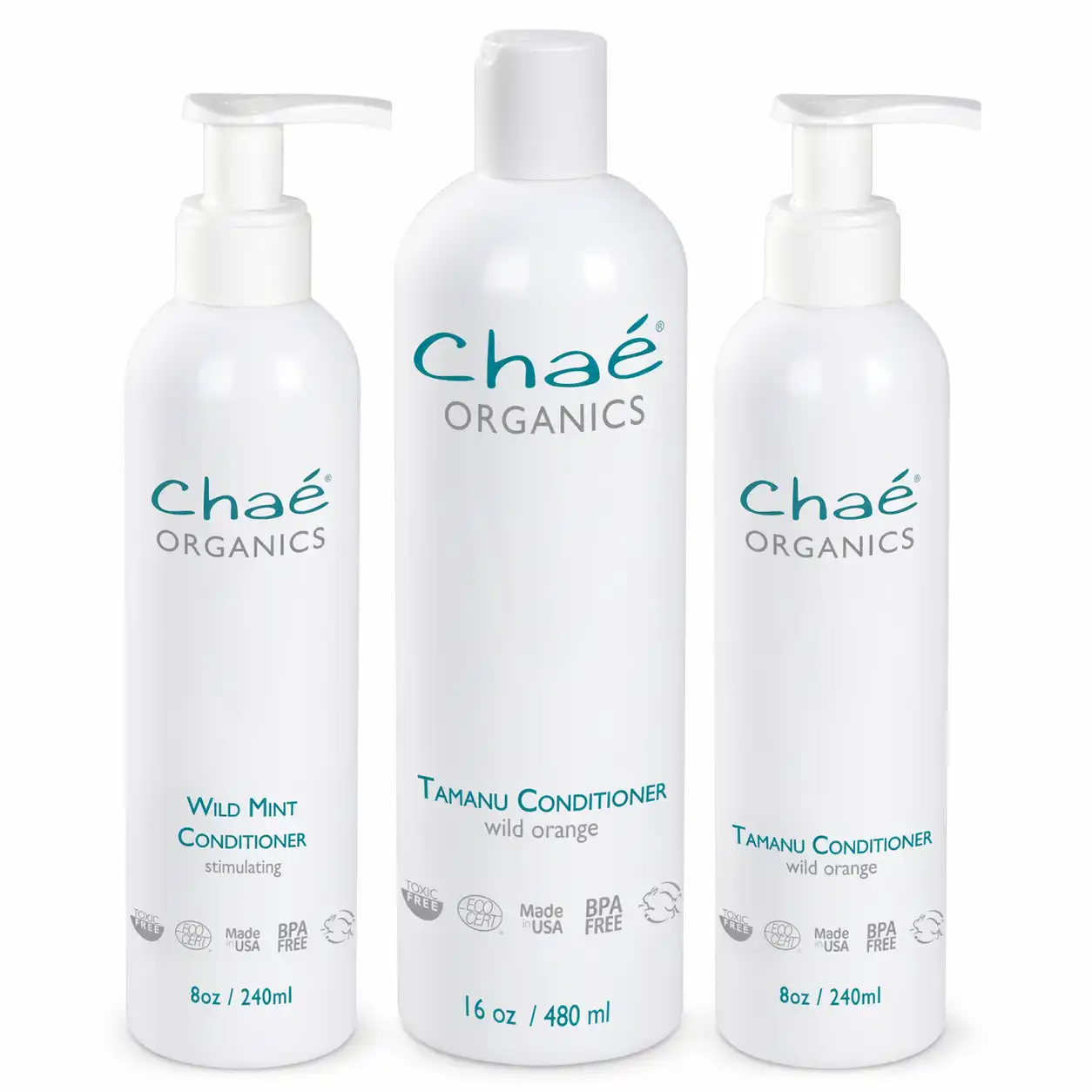
Hair Conditioner – Wild Orange or Wild Mint
Silicone-free conditioning from passion fruit, rice bran, açai, and argan oils. Wild Mint adds peppermint and tea tree for a stressed, sensitive scalp.
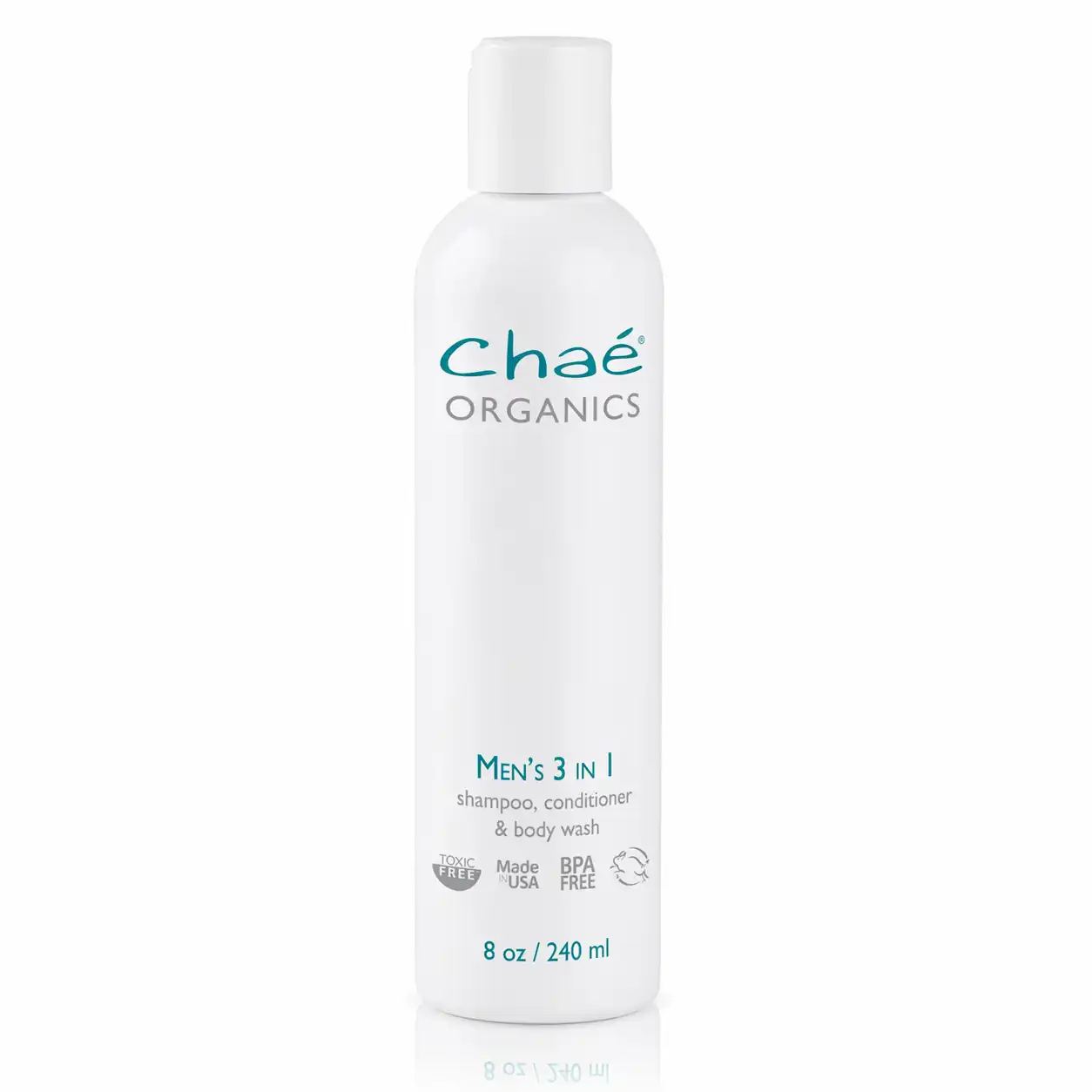
Men’s 3-in-1 Shampoo, Conditioner & Body Wash
Glucoside cleansers on an aloe and olive-leaf base. One bottle for hair, scalp, and body without the stripped feeling.
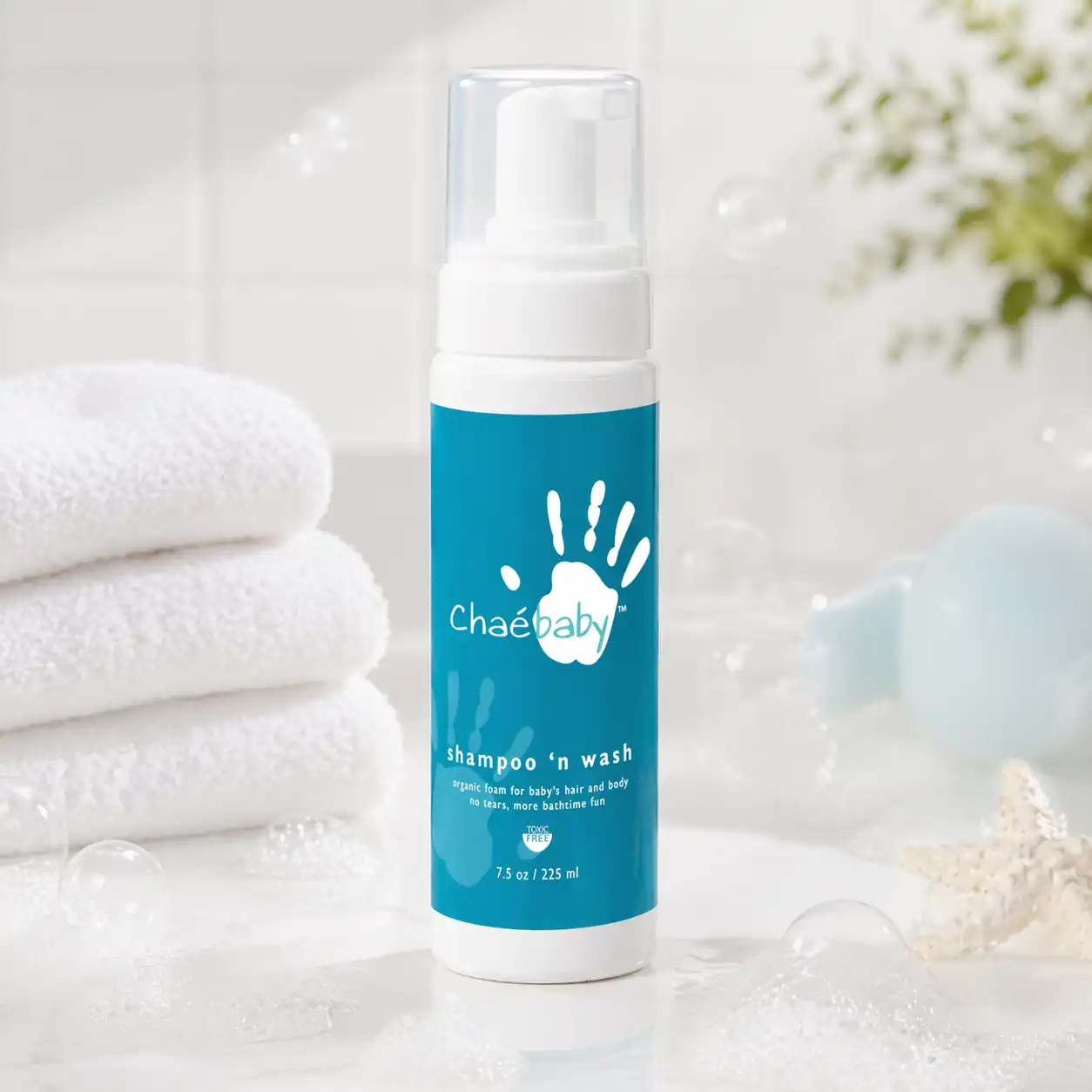
Baby Shampoo n’ Wash – 2 in 1
Five ingredients. A foaming wash for hair, body, and face with a light lavender scent, made for frequent use on sensitive skin.